Dorotea la Malfichada
Pedro PáramoDorotea la Malfichada is an elderly beggar whose visible tenderness toward a bundle and hidden history of arranging girls for Miguel Páramo make her one of Comala’s most morally complicated figures. After death, she speaks with Juan Preciado about the soul she abandoned, the sins that barred her from heaven, and the son she hoped to find there. Her story holds deprivation and culpability together: she is pitied, judged, and capable of naming her own exhaustion, but the novel does not reduce her to any one of those conditions.
Identity and Life in Comala
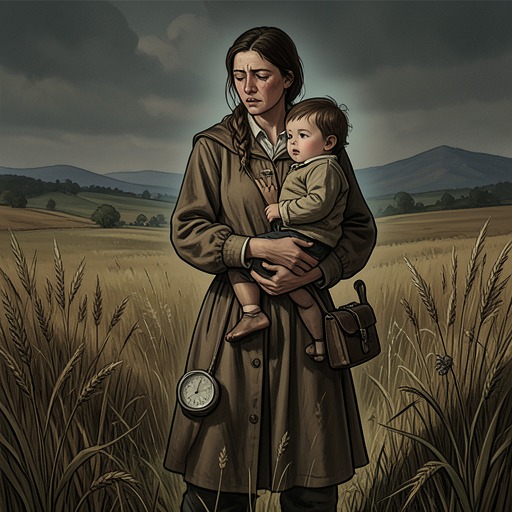
When Damiana Cisneros is asked whether she knows Dorotea, she describes a woman who rises very early to come for something to eat. Dorotea carries a bundle inside her shawl and rocks it as if it were her baby. Damiana believes some misfortune must have happened to her long ago, but Dorotea never speaks of it, so the people around her do not know what befell her. She lives on alms. The account gives her a public identity built from observable gestures and need, while leaving the private history behind them unknown.
The bundle is both a concrete sign of her daily life and an unanswered question. Others see her cradle it as a child; they cannot say what loss, if any, lies behind the gesture. The narrative neither supplies an explanation nor lets the onlookers’ speculation become fact. Dorotea’s silence preserves that gap between what the village sees and what it knows, a gap that remains important even when she later speaks at length about guilt and death.
The Soul, Death, and the Promise of Heaven
In conversation with Juan Preciado, Dorotea says she has not looked up at the sky for years. She had come to regard the earth as enough to orient herself; the sky seemed too high for her lowly perspective. More painfully, Father Rentería had told her that she would never know paradise, not even see it from afar, because of her sins. That judgment took away the hope that, in her understanding, helped a person keep putting one foot before the other: the possibility that death might carry the sufferer somewhere else. With heaven shut and hell apparently the only remaining destination, she says, life itself could seem better never to have begun.
Her account of dying gives this spiritual despair a physical image. Dorotea recalls that her soul made her food bitter and her nights intolerable with anxious thoughts and visions of the damned. When she sat down to die, the soul begged her to rise and continue bearing the burden of life, still waiting for a miracle that might cleanse her of her faults. Dorotea refused to go on. She told it that the road ended there and that she had no strength to continue; then she opened her mouth so it could leave. She felt a small thread of blood fall into her hands, the last connection between the soul and her heart. The episode presents death not as a triumphant release but as the point at which she will no longer obey either conscience or hope’s demand for endurance.
Yet Dorotea’s account also unsettles the condemnation she received. Asked where her soul might have gone, she allows that it may wander the earth like other souls, pursuing the living to ask for prayers. It might even hate her for the way she treated it. She no longer cares: she says she has recovered from its excesses of remorse. Her words do not establish what becomes of the soul; instead, they show how completely she has ceased to trust its demands. In the same exchange, she calls the place where she is now her heaven. The statement reverses the priest’s verdict without explaining or correcting it: the afterlife she inhabits is not the promised paradise she had hoped for, but it is the place she can name as heaven.
Confession and Complicity
Dorotea is also linked to Miguel Páramo’s abuse of power. In the church, she approaches Father Rentería at the confessional and admits that she was the one who found girls for Miguel Páramo. The admission is made only when, as she puts it, telling him can no longer cause harm. It identifies her as an active participant in enabling Miguel’s access to girls, not merely as a witness to his conduct. The evidence does not explain how she came to do this work or what choices were available to her, so her responsibility is present without a supplied account of its circumstances.
Her confession gains force from the contrast with her familiar image as a destitute woman carrying a bundle and seeking food. Poverty does not erase the harm involved in her actions, just as her complicity does not make the poverty unreal. The scene instead places both facts beside one another. Dorotea can be vulnerable in the village’s economy of charity and still have helped facilitate Miguel’s exploitation of others.
Father Rentería answers her confession by telling her that she is her own judge and must see whether she can forgive herself. Dorotea replies that she cannot, which is why she has come to him: she believes he can forgive her. The exchange makes the priest’s authority central to a hope she has been unable to grant herself. It also points back to the earlier sentence that denied her heaven. His later words offer forgiveness in God’s name, but they do not erase the lasting effect of the earlier judgment on Dorotea’s sense of what awaits her.
The Son and the Limits of Absolution
Dorotea had repeatedly asked Father Rentería to send her to heaven after her death so she could see whether her son was there. In recalling this wish, the priest names the hope she had carried into their earlier encounters, then tells her that she can no longer go to heaven. He nevertheless asks God to forgive her and says that he too forgives her in God’s name. Dorotea thanks him. The exchange grants the forgiveness she came seeking, but it does not promise the reunion she wanted: no evidence confirms where her son is, or whether she finds him.
The bundle she cradles as a baby and the son she hopes to find in heaven invite a connection, but the narrative does not establish that they are one and the same. What it does establish is a recurring maternal image and a concrete longing directed beyond death. In a life marked by alms, withheld history, and the burden of remorse, the hope of reaching her son gives her request for heaven a personal object. The priest’s forgiveness addresses her guilt; it cannot, on the evidence given, guarantee the fulfillment of that hope.
A Voice Among the Dead
Dorotea’s story reaches the reader through fragments of conversation and recollection rather than a continuous biography. She explains her spiritual despair to Juan Preciado, recalls the departure of her soul, and is later heard in the church’s confessional encounter with Father Rentería. These separate disclosures reveal different faces of the same character: the woman others cannot explain, the accomplice who confesses, and the dead speaker who describes why she stopped listening to her soul.
A further exchange leaves the ownership of a woman’s voice uncertain. Someone asks Dorotea whether she said what was just heard; she answers that she had been taking a little nap, while the other speaker says she heard a woman’s voice and thought it was Dorotea. The moment does not resolve who spoke. Instead, it lets Dorotea’s identity touch the novel’s unstable traffic between speech, memory, and the dead without making her the certain source of every voice around her.
That uncertainty complements the silences surrounding her life. The villagers do not know what happened to her long ago; the reader does not learn whether her hoped-for son is in heaven; and her own voice may be difficult to distinguish from another woman’s. What remains unmistakable is the movement from dependence on an external promise to a starkly local definition of consolation. Denied confidence in paradise and worn down by remorse, Dorotea names her present place as heaven, making her final spiritual geography both intimate and unresolved.